Can You Just Draw a Smiley Face on It?
In February 2025 Clone Robotics posted forty seconds of footage that got some attention. A pale, muscled, faceless body spookily hung from a rig in a workshop. It was twitching, with movements and bodyshapes that were humanlike - powered by artificial muscles under a translucent skin. The reactions arrived. "Nightmare fuel!" "Westworld was nonfiction." Or my favourite - ““I’m just curious why they made this look like so evil”.
But one comment gets us back into the art of design considerations to address the Uncanny Valley: "Can you just draw a smiley face on the head, please?"
Here was a robot with no face at all, and it seemed to disturb people more than AheadForm's sculpted heads or Engineered Arts' expressive Ameca. If the uncanny valley were only about faces, faceless robots would avoid the uncanny - wouldn’t they?
But first, what is Clone actually trying to do compared with others in robotics…
A humanoid generalist…
Many companies building humanoid robots - Tesla, Figure, Unitree, are built to look like machines and are constructed as machines but in a vaguely human shape - bipedal and with the approximate proportions of a human, with two arms and a head. They take the general sketched form of a human and build within that outline.
Clone is doing something different. Clone is seeking to build something that is constructed like a human is constructed - building from the inner details outwards. Its Protoclone has a polymer skeleton modelled on all 206 bones, over a thousand Myofiber artificial muscles pulled by water pressure rather than motors, and synthetic analogues for muscular, vascular and nervous systems. The company talks, without much embarrassment, about "synthetic humans" in a way which is distinct from many others. The android is designed to mimic human anatomy at a biological level.
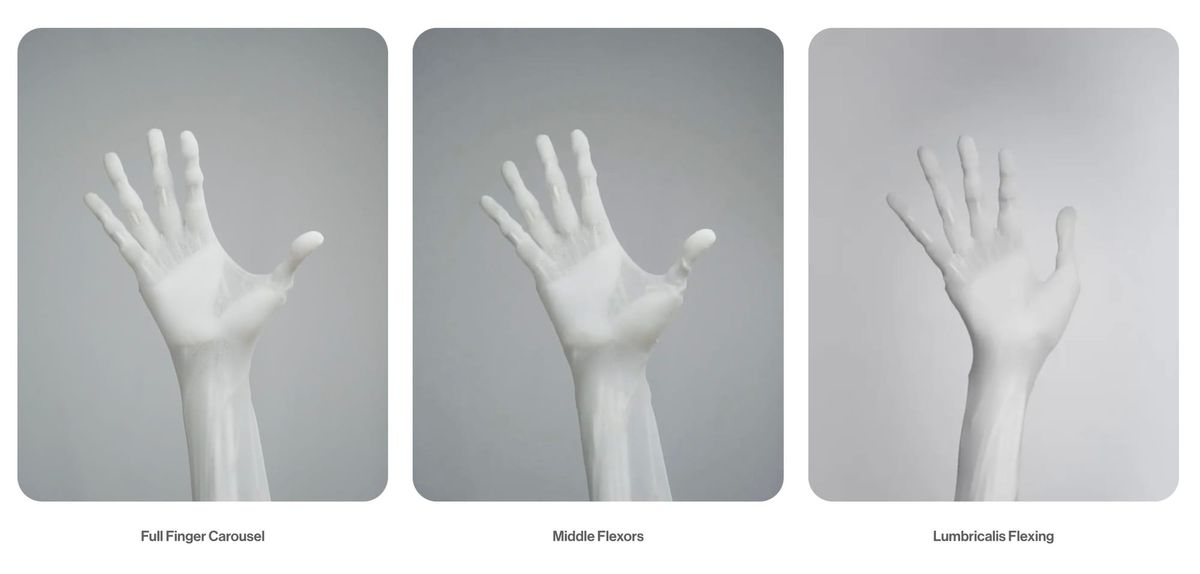
You can see why this might be useful. Fine motor control is a hard problem in robotics, but if you can achieve it you can create a robot that can be a generalist. Take the hand for example - human hands are anatomically fiddly in ways a basic two-fingered robot gripper is not. Clone's hand is widely described as about the most human-level in the business, and enables the kind of everyday manipulation that specialist industrial arms cannot generalise to - such as opening a jar or flipping a lid. If you believe that a machine which is going to do arbitrary human tasks in human environments may need to be shaped like the thing those environments were built for, then copying the anatomy stops looking indulgent and starts looking like it makes engineering sense. A generalist body for a world made by and for generalist bodies.
Or an expensive detour?
However, there is a serious case on the other side. Many others in the industry have looked at the human body in terms of function and decided not to copy it. Boston Dynamics retired its hydraulic Atlas and rebuilt it electric on a blunt principle: keep the human silhouette, because our spaces are built for it, but throw out the human range of motion. Its Atlas does a task in whatever way is most efficient, even when that means rotating a joint a full 360 degrees in a way no person could. Its head is a light ring, its hands are three-fingered grippers, its limbs pop off and are replaced in minutes, and the whole thing is designed to be hosed down and kept running. Tesla, Figure and others are making the same bet: comparatively simple to service machines with function.
Set that beside Clone's thousand water-filled muscles pulling on 206 synthetic bones - and the humanoid based on biology looks excessive. We never built aircraft that flap, and the wheel still beats the leg on a flat floor. And Clone's own chief has conceded that simulating soft, non-linear muscles well enough to teach the thing to walk is somewhat tricky. Fluidic muscle is powerful, but it needs upkeep.
My own view is that the two approaches are answering different questions. If the job is lifting boxes in a cold warehouse for a decade with almost no downtime, the serviceable, superhuman-jointed machine is plainly the right tool, and copying a body would be a costly and excessive indulgence. But if the job is the fine, general dexterity of a home or a care ward, handling a person gently, using tools that were shaped for human hands, then a body built like ours may be exactly the solution that is needed. Perhaps there is room for both.
Back to the Uncanny…
The engineering and design choices of Clone - focusing on developing a biologically accurate robot - have not so far extended fully to the face. Despite the accuracy of the body design, the head is currently a blank canvas - although we see some sneak peaks for the future.
In a previous article, I explored how robot facial designs can shape human trust and acceptance: highlighting that there is increasing sophistication in matching robot face design to specific applications and user needs.
The uncanny feeling created by Clone’s biologically accurate body paired with an absent or a blank face highlights another consideration for designers - the importance of coherence.
This is supported by research. MacDorman and Chattopadhyay (2016) tested whether the uncanny valley is driven by category uncertainty (not knowing what a thing is), or by realism inconsistency (a mismatch in how human its different parts are). If uncertainty was not the problem (and in any case nobody is uncertain about Protoclone: you know exactly what it is - and it ain’t human), then perhaps inconsistency, or incoherence, was the issue.
Protoclone is a body that strains for full anatomical realism, with a hand that moves very like a person, but with no face to anchor it. Each part is making a different claim about how human this actually is.
Our comfort with facelessness can be conditional. You trust a robot that is building a car, and you trust it without a face, because everything about it agrees on what it is and what it will do. Facelessness works when the rest of the object is clear and legible - every element of the design indicates function and task. We can understand what it is, what it is for, and what it will do. Protoclone is the reverse case: it removes the face while the body shouts, as loudly as a body can, that it is built like a person. The movements are humanlike, the design is biologically human, but the face is simply - not there.
The crowd asking for a smiley face were not asking for decoration. They were pleading for one cue, any cue, that would tell them what this thing was and importantly - whether it meant them well.
Clone - next steps
Clone’s current model hides behind a mirrored visor. The next, which Radhakrishna calls the "Neoclone", is meant to carry a neutral face. After that come the "True Clones", which the company claims will reproduce all forty facial muscles to generate micro-expressions and, in its own framing, be indistinguishable from a living person (!). The firm intends to walk the entire spectrum, from no face to full realism, in public, over the next few years.
When Clone finally puts a face on that body, what will that be like? How will people react? Will incoherence be avoided because the approach to the body and the face are equally detailed and subtle?
The challenge here for the face specifically will be immense, due to our particular human sensitivity to recognising faces. Our specialist skills in face recognition are well known and this not only means face design is of utmost importance, but also that it is the area that humans are likely to be most critical of. We are the ultimate expert critics.
We do not read a face the way we read a chair. There is dedicated machinery for it: a patch of the fusiform gyrus that Kanwisher and colleagues (1997) found responds far more strongly to faces than to objects, houses or hands. The processing is fast and largely automatic, showing up soon after we are born.
It is no wonder that Clone are leaving the face until last. Will this be a winning formula of design? Or will Ameca’s approach win-out - whose grey, genderless offerings are plainly robotic but with a homage to humanity?
Would we be happiest with a highly realistic body and face, or would we be more comfortable with clarity of artificiality? What balance will they choose?
The question to keep asking is not whether Clone can build a body that moves like ours. (It increasingly looks as though it can.) The question is whether the hyper realistic face that might be added actively steps over the uncanny valley, or whether they would be better off…just putting a smiley face on it.
(Personal note: apologies for the extended delay between articles due to various commitments and disruptions. Looking forward to writing more frequently over this year.)